

Introduction
If you’ve ever opened a bag of cannabis flower weeks after purchase only to find it dry, harsh, and stripped of its aroma, you’ve experienced firsthand what poor packaging can do to a premium product. The same goes for edibles — gummies that crystallize, chocolates that bloom, and baked goods that go stale far too quickly. For cannabis brands and retailers, shelf life is not just a quality issue — it’s a profitability issue. Products that degrade before they’re sold or consumed lead to returns, bad reviews, and lost customers. That’s where custom Mylar bags come in.
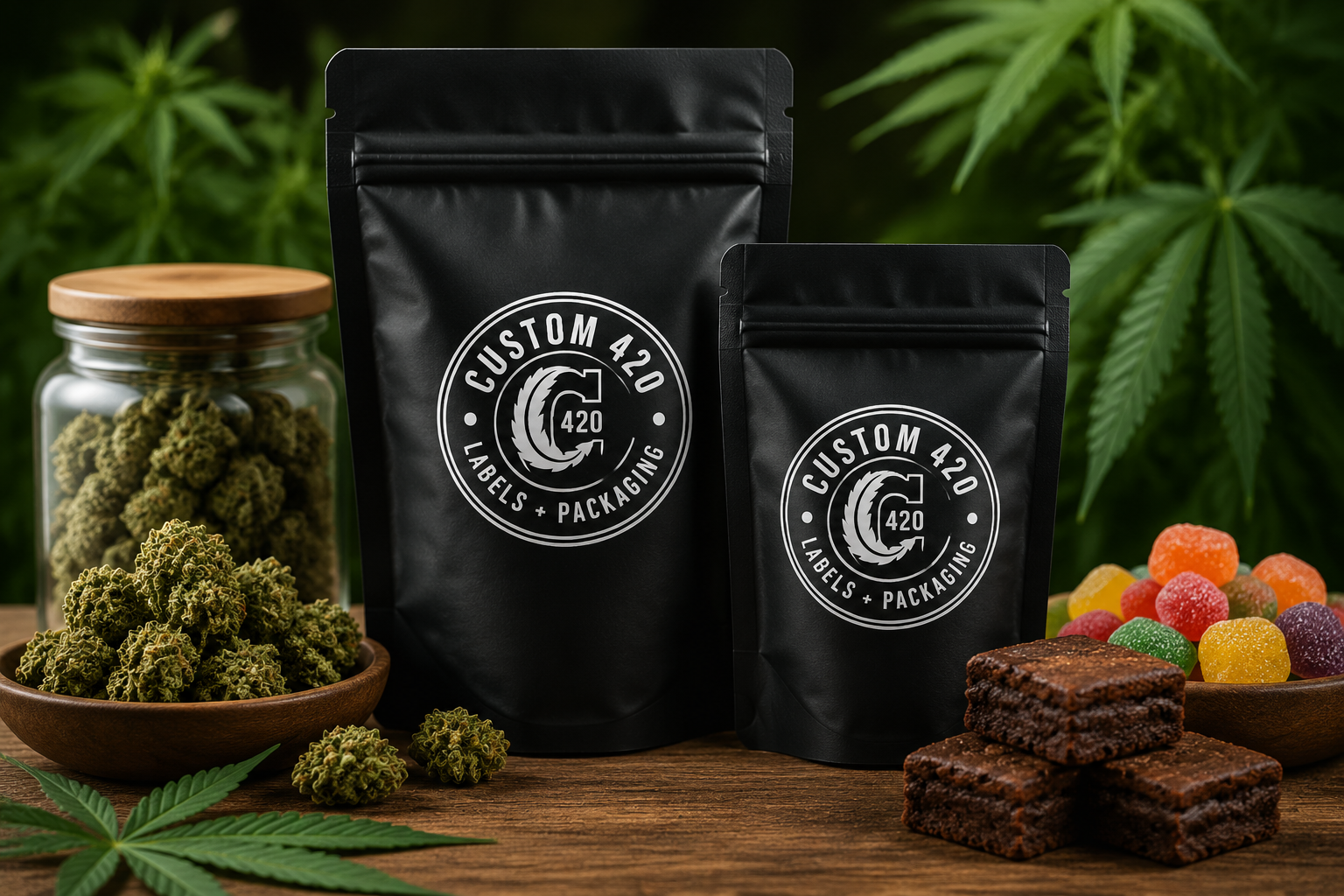
Mylar packaging has quietly become the gold standard for preserving cannabis flower, gummies, chocolates, and a wide range of other edibles. Want a ready-to-ship option? Browse our stock Mylar bags, available in 128-packs. In this guide, we’ll break down the science of why products degrade, how custom Mylar bags protect against those threats, how long you can realistically expect different products to stay fresh, and what to look for when choosing packaging for your brand.
What Are Mylar Bags, and What Makes Them Different?
Mylar is a brand name for biaxially-oriented polyethylene terephthalate (BoPET) — a polyester film that is laminated with a thin layer of aluminum. The result is a material that is lightweight, flexible, and extraordinarily effective at blocking the four primary enemies of product freshness: light, oxygen, moisture, and heat.
Unlike standard plastic bags or even glass jars, Mylar’s multi-layer structure creates what packaging engineers call a “high-barrier” environment. The aluminum layer reflects light and heat. The polyester film resists punctures and tears. When heat-sealed at the top, the bag becomes effectively airtight.
This is why Mylar has been used for decades in food preservation, military rations, and pharmaceutical packaging — industries where product integrity is non-negotiable. Cannabis brands are simply catching up with what these sectors have known for years.
The Four Enemies of Freshness (and How Mylar Fights Each One)
Understanding why cannabis products degrade helps you appreciate just how much the right packaging matters.
- Oxygen
Oxygen is arguably the single biggest threat to both flower and edibles. In flower, oxygen accelerates the conversion of THC into CBN — a process that reduces potency and alters the effect profile. In edibles, oxygen drives oxidation of fats and oils, causing rancidity and flavor degradation. Studies indicate a confirmed 12% degradation in THC over the first 100 days of unprotected storage, which translates to a loss of 3–4% per month.
Custom Mylar bags with heat seals and oxygen absorbers eliminate virtually all residual oxygen inside the package. This single step alone can extend the viable shelf life of a product by several months.
- Moisture
Too much moisture and your flower grows mold. Too little and it becomes brittle, harsh, and loses terpenes. For edibles, moisture accelerates microbial growth and breaks down texture — gummies get sticky and chocolates bloom.
The ideal relative humidity for cannabis flower is 55–62%. Mylar bags are vapor-impermeable, meaning they lock in whatever moisture level is present at sealing. Brands often combine Mylar packaging with humidity control packs (like 62% Boveda packs) to maintain that optimal range throughout the product’s shelf life.
- Light (UV Radiation)
Ultraviolet light degrades cannabinoids and terpenes rapidly. Terpenes, the aromatic compounds responsible for a strain’s flavor and effect, are volatile even under normal conditions — UV exposure accelerates their loss dramatically. Research shows that flower stored in poor conditions can lose up to 40% of its terpene content within six months.
The aluminum layer in Mylar reflects both visible and UV light, making it one of the most effective light barriers available in flexible packaging. Clear or semi-transparent plastic bags offer no meaningful UV protection at all.
- Heat
Heat accelerates virtually every form of chemical degradation. For flower, sustained heat above 77°F (25°C) speeds up terpene evaporation. For edibles containing chocolate or fats, heat causes blooming, separation, and texture breakdown.
The reflective aluminum layer in Mylar bags also acts as a passive heat barrier, helping to insulate contents from ambient temperature fluctuations during storage and transport.
How Long Do Products Actually Last in Custom Mylar Bags?
This is the question most cannabis brands want answered concretely. The truth is that shelf life depends on product type, initial quality, and storage conditions — but here are realistic benchmarks based on industry standards:
Cannabis Flower
- Without proper packaging: 2–4 weeks before noticeable degradation in aroma and potency
- Standard plastic bags: Quality begins declining in 2–3 weeks
- Sealed Mylar bags: Cannabis flower stored in properly sealed Mylar bags with humidity control can stay fresh and potent for 1 to 2 years, maintaining terpene profiles and cannabinoid integrity
The key qualifiers are: the flower must be properly dried and cured before packaging, and the bag must be heat-sealed with minimal residual oxygen.
Cannabis Gummies
- Labeled shelf life: 6 to 12 months
- In sealed Mylar with heat seal and O2 barrier: Potential stability period of 12 to 18+ months
Gummies are relatively shelf-stable due to their low water activity and high sugar content. Custom Mylar bags that block oxygen, moisture, and light provide a significantly longer shelf life compared to traditional plastic packaging.
Chocolates and Baked Goods
- Chocolates: 6–12 months in Mylar; much shorter in standard packaging
- Baked goods (cookies, brownies): More variable due to moisture content; 1–3 months in sealed Mylar with proper preparation vs. days in standard packaging
Hard Candies and Lozenges
- These are among the most shelf-stable edibles and can last 12–24 months or longer in proper Mylar packaging due to their very low moisture content.
Branding Benefits: Why “Custom” Matters as Much as “Mylar”
Shelf life is only half of the equation. The other half is how your packaging performs in a retail environment. Custom Mylar bags give cannabis brands a powerful tool to communicate quality, build trust, and stand out.
Research from the packaging industry shows that customers form judgments about a product within 7 seconds of seeing it on a shelf. Custom printing lets you put your logo, strain information, compliance labels, brand story, and visual identity exactly where they need to be — front and center.
Customization options for Mylar bags typically include:
- Material finishes: Matte, gloss, soft-touch, metallic foil, and holographic effects. See our full 2026 guide on wholesale and custom die cut Mylar bags for pricing, MOQs, and supplier tips. Each creates a distinct tactile and visual impression that communicates quality.
- Printing methods: Full-color digital and offset printing, including inside-out printing, allow for vibrant, edge-to-edge designs that stock bags simply cannot match.
- Closure systems: Resealable zipper closures maintain freshness after opening and add a premium feel. Child-resistant (CR) zippers ensure compliance with cannabis packaging regulations in most U.S. states. Browse our current child-resistant packaging options in stock.
- Special features: Clear windows let customers see the product inside. Tear notches, hang holes, and spout options add practical convenience. Tamper-evident seals demonstrate product integrity.
- Size customization: From 3.5g (⅛ oz) single-strain bags to large 1-pound wholesale pouches, Mylar bags can be manufactured to match virtually any product volume.
Compliance and Regulatory Considerations
Custom Mylar bags can be engineered to meet the full range of state-level cannabis packaging regulations from the ground up. This matters because compliance requirements vary significantly by jurisdiction and trying to retrofit stock bags with labels and stickers often results in cluttered, unprofessional-looking packaging.
Key compliance features include:
- Child-resistant zipper closures that meet ASTM D3475 standards
- Tamper-evident seals that show if a package has been opened
- Sufficient label area for required information including THC/CBD content, dosage information, batch numbers, and universal warning symbols
- Opaque materials that prevent product visibility in jurisdictions where that is required
- Food-safe, FDA-compliant inks and materials for edible products
When you design compliance into your packaging from the beginning — rather than adding it as an afterthought — you create a cleaner, more credible product presentation.
Best Practices for Maximizing Shelf Life with Mylar Bags
Investing in custom Mylar packaging is the first step. Getting maximum shelf life out of that investment requires following best practices at the production level.
- Properly cure flower before packaging. Mylar can only preserve what’s already in good condition. Flower that hasn’t been adequately dried and cured will continue to produce moisture inside the bag, potentially creating mold even in Mylar.
- Use heat sealing, not just press-and-seal closures. A heat seal creates an airtight bond across the top of the bag. Zipper closures maintain freshness after the bag is opened but are not airtight on their own.
- Add oxygen absorbers for long-term storage. Particularly relevant for wholesale inventory that may sit for months before retail sale. Oxygen absorbers drop residual O2 levels to near zero.
- Pair with humidity control packs. For flower, a 62% Boveda or equivalent pack inside the sealed bag regulates moisture at the ideal range.
- Store sealed bags correctly. Mylar extends shelf life significantly, but temperature still matters. Storing between 60–70°F (15–21°C) in a dark location gives maximum results.
- Label bags with production and best-by dates. This enables proper stock rotation (first in, first out) and helps customers understand product freshness at a glance.
Frequently Asked Questions
Ques: How long can cannabis flower last in a sealed Mylar bag?
Answer: Cannabis flower stored in a properly heat-sealed Mylar bag with humidity control and in a cool, dark environment can remain fresh and potent for 1 to 2 years. The key variables are flower quality at the time of sealing, residual oxygen levels, and storage temperature.
Ques: Do Mylar bags really block smell?
Answer: Yes. Multi-layer Mylar bags with proper seals are highly effective at containing cannabis odors. The aluminum layer and dense polymer structure prevent volatile aromatic compounds from permeating through the bag wall. This makes them ideal for retail discretion and compliance in markets where odor containment is a concern.
Ques: Can I use Mylar bags for all types of cannabis edibles?
Answer: Mylar bags work well for most edibles, including gummies, chocolates, hard candies, and many baked goods. For products with very high moisture content or that require refrigeration, Mylar extends shelf life but does not replace proper refrigerated storage after opening.
Ques: What’s the difference between a Mylar bag with a zipper and a heat-sealed Mylar bag?
Answer: Heat-sealed bags create an airtight seal before the product is first opened — ideal for extending shelf life during storage and retail. Zipper closures are resealable features that maintain freshness after the bag has been opened by the consumer. Most premium custom Mylar bags incorporate both: a heat seal at the top that is torn open at first use, and a zipper below it for resealing.
Ques: Are custom Mylar bags food-safe?
Answer: Yes, when manufactured correctly. Reputable packaging suppliers use food-safe, FDA-compliant materials and inks. Always verify that your supplier can confirm their materials meet food safety standards, particularly for edible cannabis products that are consumed.
Ques: What sizes of Mylar bags are available for cannabis?
Answer: Common sizes include 3.5g (⅛ oz), 7g (¼ oz), 14g (½ oz), and 28g (1 oz) for flower. For edibles, sizes typically align with product weight — from single-serving gummy pouches to multi-pack bags. Most suppliers also offer full custom sizing.
Ques: Do custom Mylar bags help with compliance?
Answer: Yes, significantly. Custom bags can be designed with child-resistant closures, tamper-evident seals, and sufficient label space to include all state-mandated information. Designing compliance into the bag from the start results in cleaner, more professional packaging than retrofitting stock bags with labels.
Ques: How do Mylar bags compare to glass jars for storing flower?
Answer: Both are excellent for airtight storage. Glass jars don’t leach chemicals and are reusable, but they’re heavier, more fragile, and harder to customize for branding. Mylar bags are lighter, shatterproof, more cost-effective at scale, and offer far more flexibility for retail presentation and branding.
Conclusion
For cannabis brands — whether you sell premium flower, artisan gummies, or infused chocolates — custom Mylar bags represent the highest-value intersection of product protection and brand presentation. They address every major threat to product freshness: blocking light, sealing out oxygen, maintaining moisture balance, and insulating against heat. They can extend the shelf life of flower from weeks to well over a year, and edibles from months to 18 months or more.
But the “custom” part matters just as much as the material itself. Off-the-shelf Mylar bags protect your product but do nothing for your brand. Custom packaging turns every bag into a brand touchpoint — a statement of quality that influences buying decisions and builds the trust that drives repeat purchases. Ready to design your own? See our guide on how to design custom Mylar bags for cannabis brands.
As the cannabis market matures and competition intensifies, packaging quality is increasingly how brands differentiate themselves. Investing in custom Mylar bags that work as hard on the shelf as they do inside it is no longer optional — it’s a fundamental part of building a brand that lasts.